
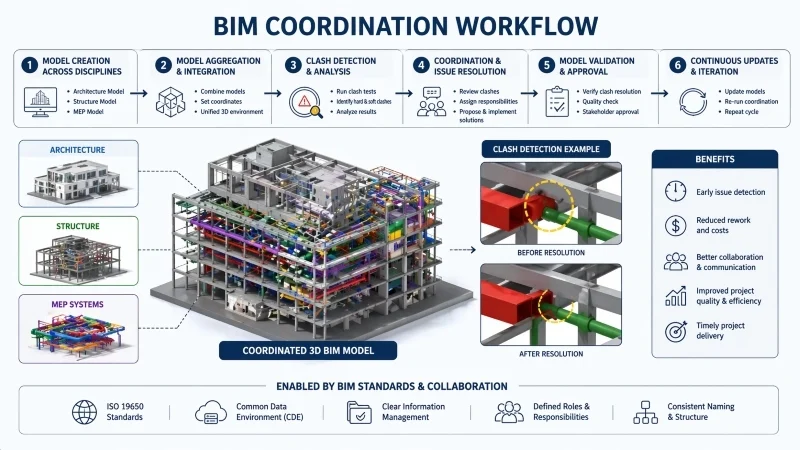
BIM Coordination Is Becoming a Continuous Process
BIM coordination is rapidly evolving from a simple review of 3D models into a continuous collaboration process between architecture, structural engineering, MEP systems, and construction teams.
Today’s platforms allow multidisciplinary models to be integrated into a shared environment, where potential conflicts can be identified before they reach the construction site. Clash detection tools can identify intersections between building systems and help teams convert those conflicts into issues that can be reviewed, assigned, tracked, and resolved during the design and coordination stages.
Identifying Problems Before Construction
Many of the most expensive construction problems occur when an incompatibility between disciplines is discovered after work has already started.
A pipe passing through a structural element, a duct conflicting with a beam, insufficient space for equipment installation, or incompatible architectural and MEP systems can result in redesign, change orders, schedule delays, and costly rework.
BIM coordination helps move these decisions to earlier stages of the project, when changes are generally easier and less expensive to implement.
From Periodic Coordination to Connected Workflows
The industry is increasingly moving away from isolated coordination meetings toward more continuous and connected workflows.
Cloud-based BIM platforms allow project teams to work with updated models, review coordination issues, track their status, and maintain a shared source of project information.
This approach helps architects, engineers, contractors, and owners communicate more effectively and make informed decisions before construction activities are affected.
Automation and Artificial Intelligence Are Expanding BIM Capabilities
The next stage of BIM coordination is increasingly connected with automation, artificial intelligence, and advanced digital environments.
New technologies are helping project teams analyze information, detect potential conflicts, manage coordination issues, and identify risks earlier in the project lifecycle.
Rather than replacing professional judgment, these technologies can strengthen the ability of BIM teams to process increasingly complex project information and support more efficient decision-making.
The Real Value of BIM Goes Beyond the 3D Model
For owners, designers, and contractors, the value of BIM is no longer limited to producing a three-dimensional model.
Its greatest potential appears when that model becomes an active tool for coordination, constructability analysis, communication, documentation, and project decision-making.
A properly implemented BIM strategy can help improve multidisciplinary coordination, reduce conflicts, increase constructability, and lower the probability of discovering costly problems once construction is already underway.
At FENIX SMART BUILD, BIM coordination is part of a project methodology focused on identifying conflicts before execution, improving integration between disciplines, and providing greater predictability throughout project development.