
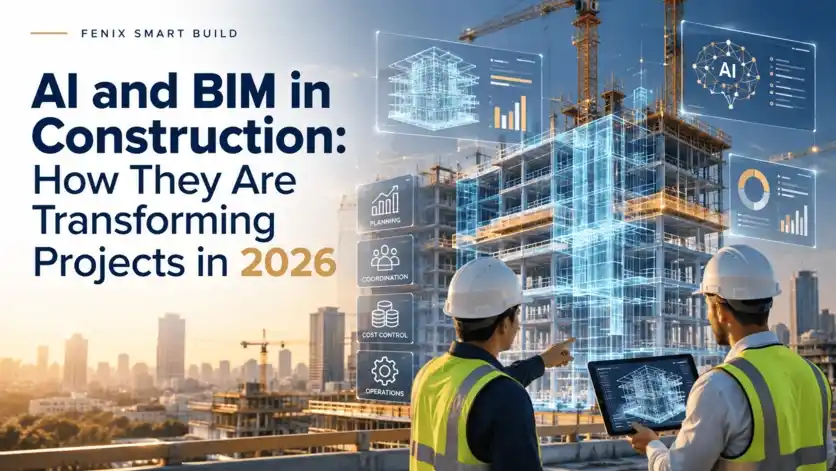
For years, Building Information Modeling (BIM) transformed the construction industry by allowing architects, engineers, and contractors to work with coordinated digital models instead of relying exclusively on 2D drawings and fragmented processes.
In 2026, that transformation is entering a new stage.
Artificial intelligence (AI) is no longer being used only as an experimental tool. It is beginning to integrate with BIM, project management platforms, planning systems, field information, and Digital Twins to help teams analyze large amounts of data, identify risks, and make decisions faster.
However, the real change is not simply about “adding AI” to a project.
The greatest potential appears when artificial intelligence works on top of a well-organized digital foundation: coordinated BIM models, reliable information, defined standards, and processes that connect design, construction, and operations.
In other words, AI can accelerate decisions, but the quality of those decisions will still depend on the quality of the project information.
From BIM Models to Intelligent Information Systems
BIM already makes it possible to centralize a large amount of information about a building: geometry, materials, structural systems, MEP systems, quantities, construction sequences, and asset data.
Traditionally, much of that information must be interpreted manually by architects, engineers, BIM coordinators, estimators, and project managers.
Artificial intelligence is beginning to change that process.
New systems can analyze information coming from models, documents, specifications, photographs, schedules, and other sources to identify relationships that might otherwise require many hours of manual review.
This does not eliminate the need for professionals.
On the contrary, it increases the importance of technical knowledge because AI can process information quickly, but critical decisions still require context, experience, engineering judgment, and construction knowledge.
The most likely future is not fully automated construction, but professional teams capable of using more intelligent digital systems to make better decisions.
1. Smarter BIM Coordination and Clash Detection
One of the clearest uses of BIM has long been multidisciplinary coordination.
Architecture, structure, HVAC, electrical systems, plumbing, and other disciplines can be combined within a coordinated environment to identify interferences before they reach the construction site.
The problem is that a complex project may generate hundreds or even thousands of possible clashes.
Not all of them have the same importance.
A more intelligent system can help classify conflicts according to their potential impact, identify repetitive patterns, and prioritize those that can truly affect construction.
This represents an important evolution.
The goal of Clash Detection should no longer be simply to identify the greatest possible number of interferences.
The real objective should be to identify and resolve early those interferences that could later become:
- rework;
- change orders;
- delays;
- material waste;
- conflicts between contractors;
- or additional costs.
The combination of BIM and AI can progressively allow the coordination process to move from being reactive to becoming more predictive.
2. AI and 4D BIM: Anticipating Problems Before They Reach the Jobsite
4D BIM connects the three-dimensional model with the project schedule.
This makes it possible to visualize how a project should be built over time and analyze sequences before the work is physically executed.
The incorporation of artificial intelligence can significantly expand this capability.
A system can analyze construction sequences, historical information, constraints, resource availability, and project progress to identify situations that could affect the schedule.
For example, a team may identify that a particular activity depends on another activity that is already delayed, that several crews need the same work area at the same time, or that a certain sequence may create a logistical conflict.
The real advantage is not obtaining a perfect prediction of the future.
That would be unrealistic.
The advantage is receiving earlier warning signs that allow the team to evaluate alternatives while there is still time to act.
In construction, solving a problem before it happens generally costs much less than solving it when workers, materials, and equipment are already mobilized on site.
3. 5D BIM, Quantities, and Cost Estimation
BIM can also connect geometry with quantities and costs.
When a model is properly developed and structured, quantities can be extracted directly from the digital information.
Artificial intelligence can help accelerate tasks related to classification, element recognition, information review, and estimate analysis.
In 2026, commercial AI tools are already being incorporated into estimating and takeoff workflows.
But once again, a fundamental condition appears:
automating a calculation based on incorrect information only allows an incorrect result to be obtained faster.
For this reason, model quality, parameters, BIM standards, and quality-control procedures remain essential.
Technology can accelerate the process; reliability depends on having a sound information structure.
4. From BIM to the Digital Twin
One of the most important changes is occurring after construction.
For many years, a significant amount of BIM information lost value once a building was completed.
Digital Twin technology is changing that approach.
A Digital Twin can connect the digital model of an asset with information coming from real operational systems.
This allows BIM to move beyond being only a design and construction tool and also become a platform for understanding how a building is actually performing.
Data from equipment, maintenance activities, sensors, energy consumption, and other systems can progressively be incorporated into a digital environment.
Artificial intelligence can analyze that information to recognize patterns, detect abnormal behavior, and support maintenance strategies.
The result can be a transition from primarily reactive maintenance toward increasingly preventive and predictive operations.
This significantly increases the potential value of BIM information throughout the entire life cycle of the asset.
5. AI Needs Good Data
It is easy to focus on new tools and forget a fundamental reality:
artificial intelligence depends on the data it receives.
A project with outdated models, duplicated information, inconsistent parameters, scattered files, and unclear responsibilities does not automatically become an intelligent project simply by incorporating AI.
In fact, automating processes based on poor-quality information can increase the speed at which errors are propagated.
That is why elements such as Common Data Environments (CDEs), BIM standards, BIM Execution Plans, model audits, quality control, and consistent information structures are becoming increasingly important.
Before asking, “What AI tool do we need?”, many organizations should ask another question:
Is our information sufficiently organized and reliable for an intelligent tool to use it correctly?
This may be one of the most important questions in the digital transformation of construction.
6. Will Artificial Intelligence Replace BIM Professionals?
Probably not in the way some predictions suggest.
Many repetitive tasks can certainly be automated.
Preliminary reviews, information classification, generation of alternatives, document analysis, and certain modeling activities can increasingly be performed more quickly.
But construction involves decisions that combine technical information with factors that do not always appear inside a model:
constructability, safety, field experience, material availability, contractual conditions, relationships between teams, and knowledge of construction methods.
The value of professionals will likely shift progressively from executing certain manual tasks toward interpreting information, supervising automated results, and making decisions.
The BIM Manager, BIM Coordinator, engineer, or project manager of the future will not need to know less.
They will need to know how to use more powerful tools without losing technical judgment.
7. The Real Objective: Better Decisions
Technology only creates value when it solves real problems.
A project should not implement AI simply because it is a trend.
It should implement it if it can help:
reduce errors, improve coordination, anticipate risks, control costs, optimize schedules, or manage an asset more effectively.
BIM provides a digital structure for organizing much of the project information.
Artificial intelligence can help interpret that information more quickly.
Digital Twins can extend that information into operations.
When these technologies are properly connected, something far more important than an individual tool emerges: a continuous flow of information from design through construction and operations.
How Should a Construction Company Prepare?
It is not necessary to transform an entire organization overnight.
A more practical approach is to begin by identifying where the greatest information losses or inefficiencies currently occur.
It may be MEP coordination.
It may be quantity control.
It may be planning.
It may be jobsite tracking.
It may be the handover of information to the owner.
Once the problem is identified, BIM and new AI tools can be incorporated specifically where they can produce measurable results.
Technology should adapt to the workflow and the project objective, not the other way around.
The Future of BIM Will Be Increasingly Intelligent
BIM is not disappearing with the arrival of artificial intelligence.
It is evolving.
BIM models provide one of the most important information structures available for digitizing the built environment.
Artificial intelligence increases our ability to analyze that information.
Digital Twins allow that information to remain active during operations.
The combination of these technologies can transform the way projects are designed, coordinated, built, and managed.
But one condition will likely remain valid regardless of how much technology advances:
the best digital tools create the greatest value when they are supported by strong processes and professionals who understand how projects are actually built.
At Fenix Smart Build, we combine construction experience with BIM and digital workflows to help owners, architects, engineers, and contractors improve the planning, coordination, and execution of their projects.
From BIM Design Consulting and BIM Coordination & Clash Detection to 4D/5D BIM, Digital Twin Solutions, and Facility Management, our goal is to transform digital information into better project decisions.
Smart Design. Better Coordination. Better Projects.